I Agree and I Said I Was Sorry It Wont Happen Again Ty
Why do the British say 'deplorable' so much?
(Image credit:
Allison Turrell/Flickr/CC Past-NC-ND ii.0
)
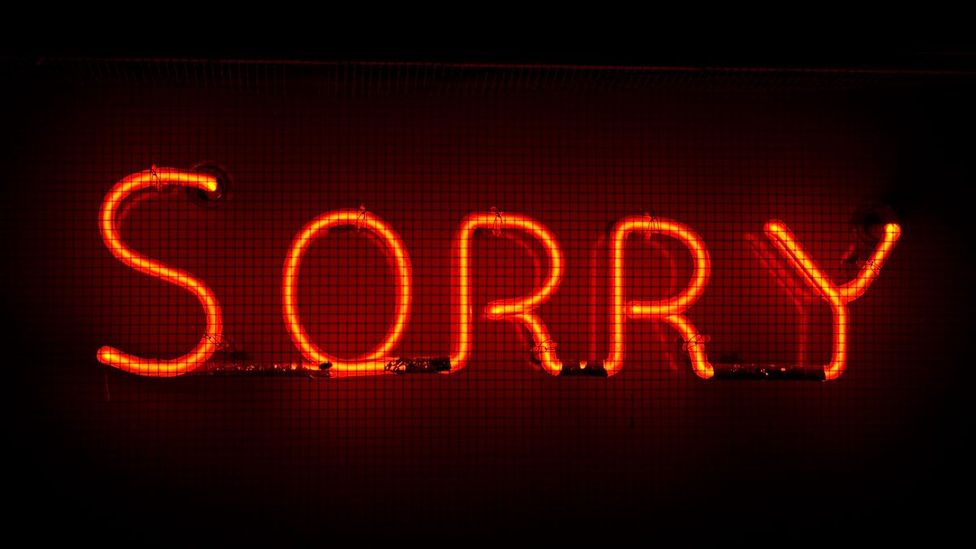
The British are famous for how ofttimes they say 'distressing' – even when they're not at error. But does the data concur upward this stereotype? And is apologising so often actually that bad?
I
It is probably the most over-used word in the United kingdom: whether they are sorry near the weather or sorry because someone else has bumped into them, chances are your average Briton has blurted out at least 1 apology in the past hour or 2.
A recent survey of more than than 1,000 Brits establish that that the boilerplate person says 'sad' around 8 times per day – and that one in eight people apologise up to 20 times a twenty-four hour period.
"The readiness of the English to apologise for something they haven't done is remarkable, and it is matched by an unwillingness to apologise for what they have done," wrote Henry Hitchings in his aptly-titled Sorry!: The English and their Manners.
But exercise the British really apologise more than often than members of other cultures? If so, what's the reason for this peculiar verbal tic… and how bad a habit is information technology?
Getting reliable data on the frequency of apologies in different countries is harder than you might recollect. "There's certainly speculation that Canadians and Brits apologise more than than Americans, but it's difficult to report in a way that would provide whatsoever compelling testify," says Karina Schumann, a psychologist at the University of Pittsburgh who studies apologies and forgiveness.
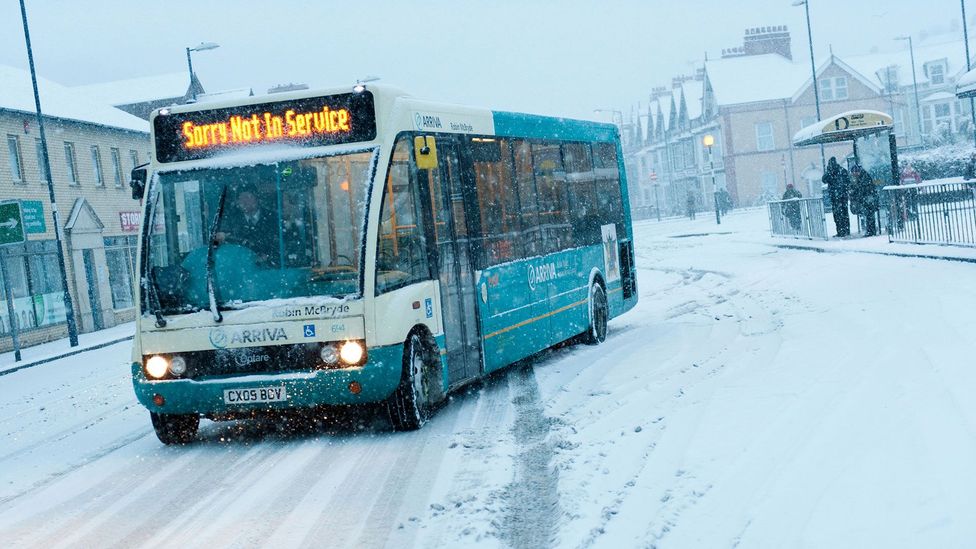
It'southward difficult to study the apply of the word 'sorry' in a way that would provide compelling evidence (Credit: Alamy)
1 approach is to inquire people what they'd practise in a theoretical situation. For instance, a recent YouGov poll of more 1,600 British people and 1,000 Americans revealed that in that location would exist approximately 15 British 'sorries' for every ten American ones if they sneezed, if they corrected someone'south mistake, or if someone crashed into them.
But the survey found similarities betwixt the British and American respondents, also: just under three-quarters of people from either land would say sorry for interrupting someone. And 84% of Brits would apologise for being late to a coming together, compared to 74% of Americans.
Exercise as I say, non as I exercise
However, asking someone what they'd do in a theoretical situation is very different to measuring what they'd do in real life. Take the last example; in the YouGov survey, 36% of British respondents said they would apologise for someone else'southward clumsiness, compared to 24% of Americans.
Just in her volume Watching the English, social anthropologist Kate Pull a fast one on describes experiments in which she deliberately bumped into hundreds of people in towns and cities beyond England. She besides encouraged colleagues to do the same abroad, for comparison.
Play tricks found that around lxxx% of English language victims said 'sorry' – fifty-fifty though the collisions were conspicuously Fob'due south fault. Oft the apology was mumbled, and mayhap people said it without fifty-fifty realising it, but compared to when tourists from other countries were bumped, the deviation was marked. "Only the Japanese seemed to have anything even approaching the English language deplorable-reflex," Fox writes.
The origins of the word 'sad' tin can exist traced to the Old English 'sarig' meaning "distressed, grieved or total of sorrow", merely of form, nearly British people employ the give-and-take more than casually. And herein lies some other problem with studying cultural differences in languages. "Nosotros use the discussion 'sad' in different ways," says Edwin Battistella, a linguistics expert from Southern Oregon University and author of Sorry About That: The Language of Public Apology. Brits might say sorry more than oft, simply this doesn't necessarily hateful they're more remorseful.
"We can use it to express empathy – so I might say 'sorry about the pelting'," says Battistella. "Information technology might be that British and Canadian speakers utilize that kind of 'sorry' more oftentimes, but they wouldn't exist apologising, per se. Other researchers have talked about the use of 'pitiful' to communicate across social classes, where you're sort of apologising for your privilege."
British society values that its members testify respect without imposing on someone else's personal space, and without drawing attending to oneself: characteristics that linguists refer to every bit "negative-politeness" or "negative-face". America, on the other hand, is a positive-politeness society, characterised by friendliness and a desire to experience role of a group.
As a consequence, Brits may sometimes use 'lamentable' in a fashion that can seem inappropriate to outsiders, including Americans. The British will say 'sorry' to someone they don't know considering they'd like to inquire for some information, or to sit down next to them – and considering non saying 'deplorable' would establish an even greater invasion of that stranger's privacy.
"Our excessive, oftentimes inappropriate and sometimes downright misleading utilise of this discussion devalues it, and it makes things very disruptive and hard for foreigners unaccustomed to our ways," says Fob. All the same, she adds, "I don't think maxim sad all the time is such a bad thing. It even makes sense in the context of a negative-politeness civilization… Of all the words that a nation could cull to scatter about with such random profligacy, surely 'sorry' is not the worst."
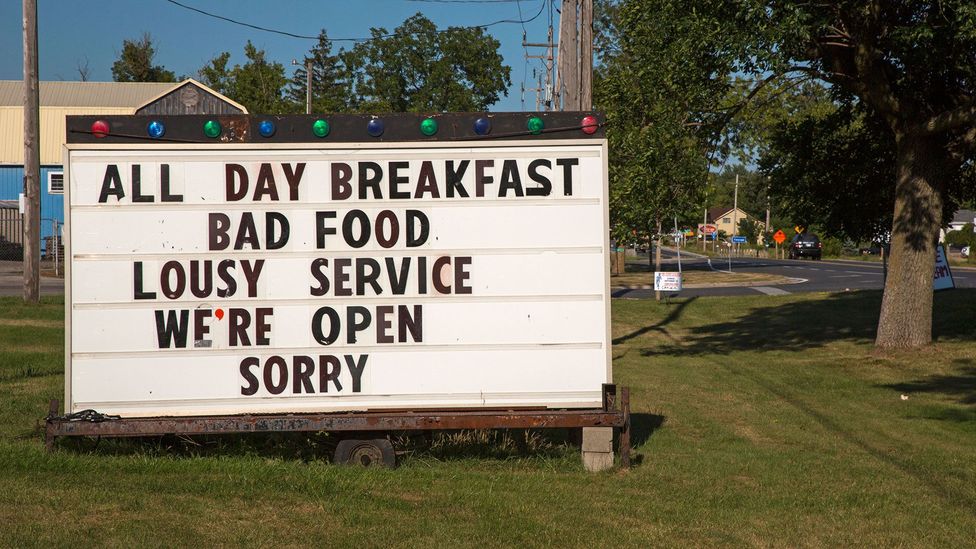
Does the excessive – even inappropriate – use of the give-and-take 'pitiful' devalue information technology? (Credit: Alamy)
There may be other benefits to saying 'sorry', too – such as fostering trust. Interestingly, that is truthful even when people are apologising non for mistakes they've made, merely rather for circumstances beyond their command.
In ane study, Harvard Business School's Alison Wood Brooks and her colleagues recruited a male actor to arroyo 65 strangers at a United states of america train station on a rainy day and ask to borrow their telephone. In half the cases, the stranger preceded his asking with: "Distressing virtually the rain". When he did this, 47% of strangers gave him their mobile, compared to only 9% when he simply asked to borrow their phone. Farther experiments confirmed it was the amends near the weather that mattered, not the politeness of the opening judgement.
"By maxim 'I'grand sorry most the pelting', the superfluous apologiser acknowledges an unfortunate circumstance, takes the victim's perspective and expresses empathy for the negative circumstance – even though it is outside of his or her control," says Wood Brooks.
Of class, the British aren't the only group known for being atoning. Women are often presumed to be, too.
To exam if this stereotype stood up to scrutiny, Schumann recruited a group of university students to go on a periodical for 12 days. They listed every situation they encountered where they felt an apology was deserved and whether or not one had been given. She constitute that the women did say 'distressing' more oftentimes than the men, simply they also reported more offenses when they thought an amends was needed – both for when they were the victim and when they were the perpetrator. When this was taken into account, men and women proved equally probable to apologise for their transgressions. "Information technology's not so much that men are unwilling to apologise; it's just that they're seeing fewer offenses that deserve an apology," Schumann says.
A sign of weakness?
And then what about those circumstances when we are aware that we genuinely owe someone an apology? Is information technology better to swallow your pride and say y'all're sorry, or – as the legendary American actor John Wayne put it – is apologising a sign of weakness?
"People worry that an apology will serve as an admission of liability, rather than as an effort to empathise with the wronged party," says Wood Brooks. But she adds "effective apologies accost the recipients' feelings – they don't prove a point. A good apology is unlikely to backfire, and is more than likely to increase trust than not apologising at all."
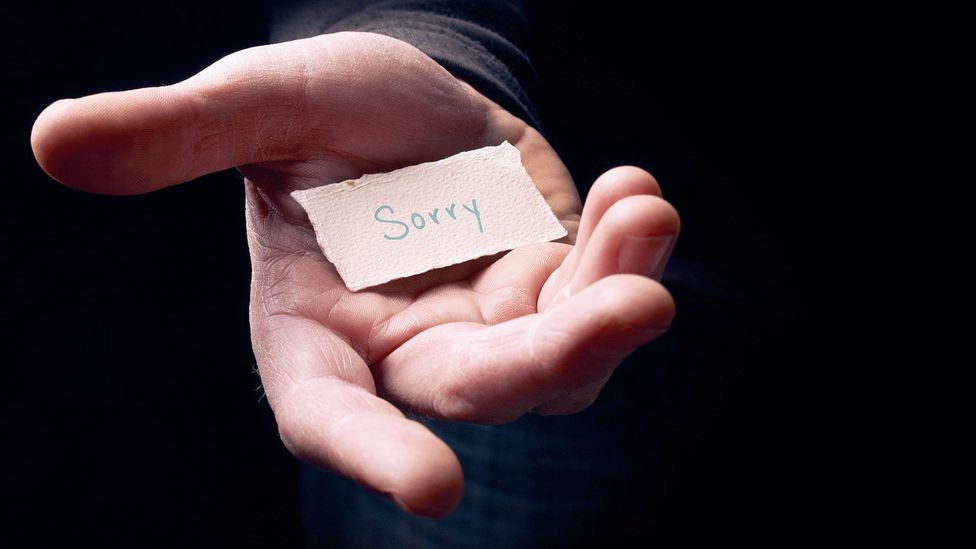
An effective apology addresses the recipients' feelings – and is probable to increase trust more than not apologising at all (Credit: Alamy)
Every bit for how to practise it, Battistella has the post-obit communication: "The correct mode to apologise is the way your mother taught yous." Say you threw a stone at a sibling. "She'd accept you go and await them in the eye in the heart and say: 'I'm sorry I threw the rock at you and I won't practise it again'. Information technology's important to name what you did wrong, to show yourself as being penitent in some way and to indicate what might be different in the futurity," Battistella says.
Just how many times you'll need to repeat the amends may vary according to where you live. Forest Brooks and Harvard PhD pupil Grant Donnelly accept nerveless preliminary data that suggests that, for a minor transgression, the optimal number is a single "I'chiliad pitiful".
"If the transgression is large, so making two apologies seems to be the magic number for conveying empathy, remorse and restoring trust and liking," Wood Brooks says.
Of grade, if y'all're British, you may demand to double that. "A unmarried 'sorry' does not count every bit an apology: we have to echo it and embellish information technology with a lot of adjectives," says Pull a fast one on.
Apologise for the pelting while y'all're at information technology, also.
Follow BBC Hereafter on Facebook , Twitter , Google+ and LinkedIn . This story is a part of BBC United kingdom of great britain and northern ireland – a series focused on exploring this extraordinary isle, one story at a time. Readers outside of the U.k. tin meet every BBC U.k. story past heading to the Britain homepage ; you also can meet our latest stories by following us on Facebook and Twitter .
Source: https://www.bbc.com/future/article/20160223-why-do-the-british-say-sorry-so-much
0 Response to "I Agree and I Said I Was Sorry It Wont Happen Again Ty"
Post a Comment